
Your Childhood Shaped You, But Does It Have to Define You?


As a Child, You Had to Adapt. As an Adult, You Have the Power to Choose.
Perhaps you've spent time looking back at your childhood and finally understanding why you behave in certain ways.
Why you avoid conflict.
Why you constantly seek approval.
Why rejection affects you so deeply.
Why you struggle to say no.
Why you feel responsible for everyone else's happiness.
Or why, despite everything you've accomplished, a quiet voice inside still whispers:
"I'm not good enough."
Understanding where these patterns began can be incredibly valuable.
But there comes a point in the healing process when another question becomes even more important:
Now that I understand where this came from, what do I choose to do with it?
Your childhood may explain many things about you.
But it does not have to become a life sentence.
As a Child, You Had to Adapt
Children have very little control over their environment.
You didn't choose your parents.
You didn't choose your family's circumstances.
You didn't choose how adults communicated.
You didn't choose whether affection was freely expressed.
You didn't choose the emotional atmosphere inside your home.
You depended on adults for safety, food, shelter, belonging and love.
So you adapted.
And your developing mind became remarkably good at discovering what helped you function within that environment.
Perhaps you learned:
"If I'm good, I'm loved."
So you became the good child.
Perhaps you learned:
"If I keep everyone happy, there won't be conflict."
So you became a people-pleaser.
Perhaps expressing emotions led to criticism.
So you learned:
"It's safer to keep everything inside."
Perhaps you received attention mainly when you achieved something.
And somewhere inside, achievement became connected with worth:
"I have to succeed to be enough."
These responses weren't character flaws.
They were adaptations.
At one point, they may even have been useful.
The problem begins when a strategy created by a child, and continues directing the life of an adult.
The Environment Changes, but the Pattern Can Remain
Imagine you learned very early that disagreement created conflict.
Your subconscious makes a simple association:
Disagreement = danger.
Fast-forward thirty years.
You're sitting in a meeting and disagree with your manager.
You're an adult.
You're competent.
You're safe.
You have choices.
Yet suddenly you feel uncomfortable.
Your heart beats faster.
You hesitate.
And instead of expressing your opinion, you remain silent.
Consciously, you may later ask:
"Why didn't I say something?"
The answer may have very little to do with that meeting.
Your present situation activated an old learned response.
The circumstances changed.
The pattern didn't.
This is one reason understanding our childhood can be so useful.
Not because we need someone to blame.
But because we can finally recognize:
"This reaction made sense then. Does it still make sense now?"
You Are No Longer That Child
This is the part of the conversation about childhood that I believe deserves much more attention.
As a child, your choices were limited.
Today, they are different.
You can choose who enters your life.
You can create boundaries.
You can leave relationships that repeatedly hurt you.
You can learn how to communicate differently.
You can surround yourself with people who support you.
You can ask for help.
You can learn emotional regulation.
You can challenge beliefs you formed decades ago.
And perhaps most importantly:
You can decide who you want to become.
Psychologist Albert Bandura, one of the most influential figures in modern psychology, devoted much of his work to the concept of human agency.
Agency refers to our capacity to influence our own functioning and circumstances through our actions. Bandura described people not simply as products of their environment, but as active participants capable of intention, forethought, self-regulation and reflection.
Your environment influences you.
Your experiences influence you.
Other people influence you.
But influence is not the same as destiny.
Your Brain Is Still Learning
There is another reason we can move beyond old patterns.
Your brain isn't finished changing.
The brain has the capacity to adapt in response to experience, learning and practice—a property known as neuroplasticity.
For a long time, people tended to think about the brain as becoming essentially fixed after childhood.
Neuroscience has transformed that understanding.
Research shows meaningful plasticity in the adult brain, although the degree and mechanisms of plasticity differ by brain system, age, and experience.
This matters enormously when we talk about childhood patterns.
If your brain learned one response through experience, it is capable of learning new responses through new experiences.
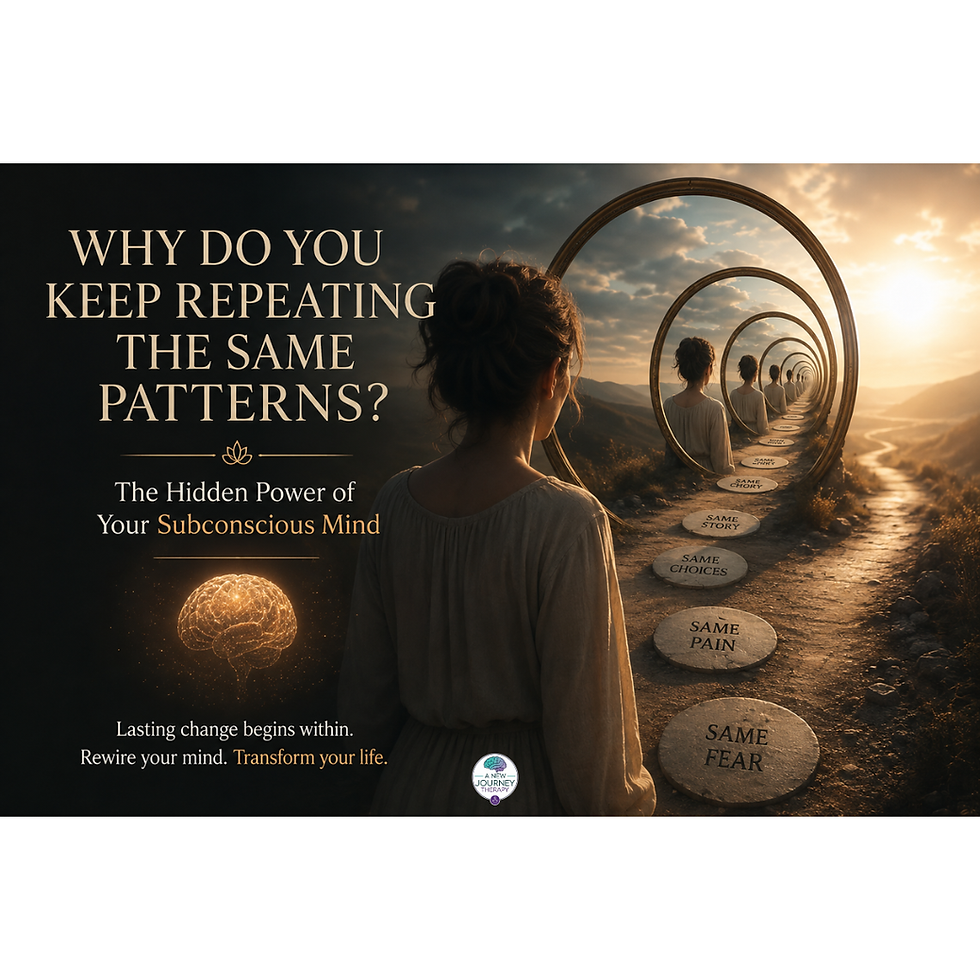
Think about a path through a forest.
You've walked the same route hundreds of times.
The path becomes clear and automatic.
Now imagine choosing another route.
At first, it feels unfamiliar.
You have to pay attention.
You have to make a conscious choice.
But every time you travel that new route, it becomes easier.
Eventually, there is another path.
Our psychological patterns can work similarly.
Familiar does not necessarily mean permanent.
Resilience Can Be Strengthened
Research into resilience gives us another important reason for hope.
Resilience doesn't mean pretending difficult experiences didn't affect us.
It doesn't mean simply "getting over it."
It refers to our capacity to adapt and function despite adversity.
The Center on the Developing Child at Harvard University notes that the capabilities underlying resilience can be strengthened at any age. Supportive relationships, adaptive skills, and opportunities to build a sense of mastery and control all contribute to resilience.
That is an important message.
Because sometimes we speak about childhood as though everything was permanently decided before adulthood began.
It wasn't.
You continue having experiences.
You continue forming relationships.
You continue learning.
You continue developing.
And every healthier experience can provide your mind with new information.
Your Past May Explain Your Reaction—But You Can Choose Your Response
Imagine someone doesn't return your message.
An old belief might immediately say:
"They're rejecting me."
Your emotional response follows.
Anxiety.
Fear.
Overthinking.
Perhaps you send several messages.
Or maybe you withdraw completely before they have a chance to reject you.
But what happens when you become aware of the pattern?
You create a pause.
And inside that pause is something incredibly powerful:
choice.
You can ask:
"Is this actually rejection—or is this an old fear interpreting the situation for me?"
Then you can choose a different response.
At first, that choice may feel uncomfortable.
That's normal.
You're stepping outside something familiar.
But every new response gives your brain a new experience.
And new experiences create new learning.
Stop Asking Only, "Why Am I Like This?"
Understanding why matters.
But eventually we need another question.
Instead of continually asking:
"Why am I like this?"
try asking:
"Who do I want to be now?"
If childhood taught you to stay quiet, perhaps today you choose to have a voice.
If childhood taught you to earn love, perhaps today you learn that healthy love doesn't require constant performance.
If childhood taught you to put everyone else first, perhaps today you discover that your needs matter too.
If childhood taught you that mistakes were dangerous, perhaps today you allow yourself to learn, experiment and grow.
And if childhood taught you:
"I'm not enough,"
perhaps adulthood becomes the place where you finally challenge whether that belief was ever true.
You Don't Have to Reject Your Past to Outgrow It
Transformation doesn't require fighting the person you used to be.
I believe we can approach our old patterns with something much more powerful:
understanding.
That child was doing the best they could with the understanding and resources they had.
Perhaps people-pleasing created safety.
Perhaps perfectionism brought approval.
Perhaps staying quiet prevented conflict.
Perhaps emotional distance protected you from disappointment.
You can look at those strategies and say:
"Thank you. You helped me then."
And then:
"I don't need you in the same way anymore."
There is something incredibly freeing about recognizing that an old pattern doesn't need to be hated before it can be released.
We can appreciate why it developed while choosing something more appropriate for our lives today.
From Awareness to Choice
This is where real transformation begins.
First, we discover the pattern.
Then we understand where it came from.
Then we ask whether the belief underneath it still serves us.
And finally, we begin creating and practicing something different.
Awareness gives us understanding.
Choice gives us direction.
And repetition helps that new direction become increasingly familiar.
This doesn't mean every deeply rooted pattern disappears instantly or that change is always easy.
It means you are no longer limited to repeating something simply because you learned it first.
You can learn again.
Your Childhood Was the Beginning of Your Story
Your childhood matters.
Your experiences matter.
Your wounds matter.
And so does your capacity to grow beyond them.
You can acknowledge what happened without building your identity around it.
You can understand your parents without excusing harmful behaviour.
You can have compassion for the child you once were without asking that child to continue making your adult decisions.
Perhaps healing eventually becomes the moment when you say:
"I understand why I became this way."
And then:
"Now I get to decide who I become next."
Your childhood may have given you your first beliefs about yourself.
Your experiences may have reinforced them.
Your subconscious may have carried them for decades.
But your story is still being written.
As a child, you had to adapt to the world around you.
As an adult, you have the opportunity to create the world within you.
And from there, you can begin creating a different life.
Coming Next: From Understanding the Past to Changing the Pattern
Understanding your childhood is powerful.
Choosing something different is even more powerful.
But what happens when you consciously know what you want to change, yet the same emotional reaction keeps appearing automatically?
In Part 3, we'll explore why awareness alone sometimes isn't enough, how subconscious beliefs can continue influencing adult behaviour, and how approaches such as Rapid Transformational Therapy can help you explore the root of a pattern, reframe its meaning and begin reinforcing a new way of thinking and responding.
Because ultimately, the goal isn't to spend your life understanding your past.
The goal is to use that understanding to create your future.


Comments