
Why Anxiety Doesn't Go Away (Even When You're Trying Hard)

You've read the books. You've tried the breathing exercises. You've told yourself, more times than you can count, to just calm down, stop worrying, and get on with it.

And yet the anxiety is still there.
If that sounds familiar, I want to offer you something most wellbeing advice skips over: it's not because you're not trying hard enough. It's because trying harder is the wrong tool for the job.
The Part of You That Willpower Can't Reach
Here's something I wish someone had told me earlier.
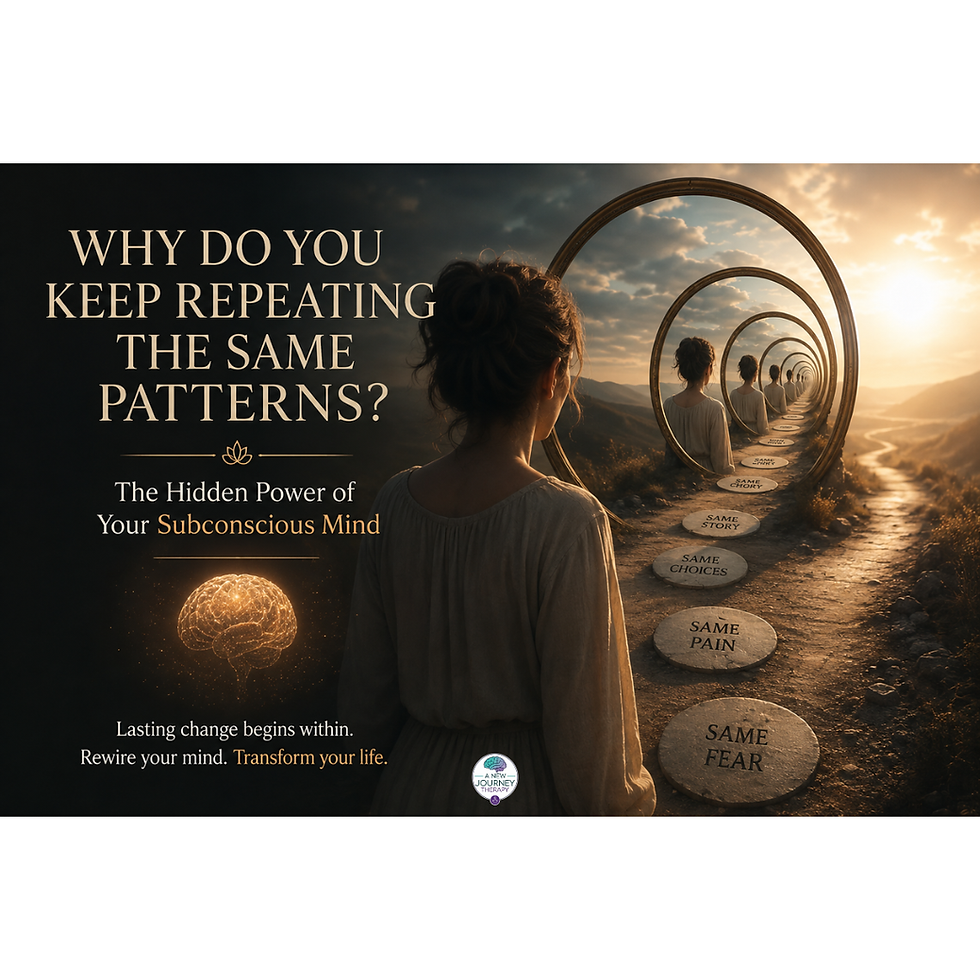
Your conscious mind — the one doing the trying, the reasoning, the positive thinking — accounts for roughly 5% of your mental activity. The other 95% is your subconscious: the part that runs your emotional responses, your habits, your automatic reactions, and the deep beliefs you formed about yourself and the world long before you had any real say in the matter.
Anxiety, at its root, is almost never a conscious problem. It's a pattern your subconscious learned — often in childhood, often as a genuine act of self-protection — and has been running faithfully ever since.
The subconscious doesn't update itself just because you've decided you want to feel different. It protects what it knows. That's its job.
So when you try to manage anxiety through willpower, discipline, or positive thinking alone, you're working at the conscious level while the pattern keeps firing from somewhere much deeper. You can make progress. You can manage the symptoms. But the root stays untouched.
What "Root Cause" Actually Means
When I work with clients, we don't spend our time analyzing the anxiety as it exists today. We go further back.
We look at the belief that first made anxiety feel necessary.
For many women I work with — women in their 40s and 50s, often accomplished, capable, and used to solving problems — the anxiety they carry as adults traces back to a much younger self who learned that the world was uncertain, that she had to be on guard, that her value depended on her performance, or that needing help was weakness.
Those beliefs weren't created out of thin air. They made complete sense to a child navigating her world. And the subconscious, which is extraordinarily loyal, has been protecting her from that perceived threat ever since.
The problem is that the child's threat is not the adult woman's reality. But the subconscious hasn't been told that yet.
What RTT Does Differently
Rapid Transformational Therapy works at the level where the pattern lives.
Using a focused state of relaxed attention — what we call hypnosis, though nothing like what you've seen on television — we access the subconscious directly. Not to dig up the past for its own sake, but to find the belief that's still running, understand where it came from, and update it.
In a single session, most clients experience a shift they describe as immediate and profound. Not because something magical happened, but because the subconscious received new information — and new information, delivered in the right state, actually sticks.
This is also why the personalized transformation recording you receive after each RTT session matters so much. Listening daily for 21 days reinforces the new pattern at the subconscious level, letting the change consolidate while your nervous system adjusts to a different way of moving through the world.
A Note for the Women Who Have Already Tried Everything
If you're reading this and you've already been to therapy, tried medication, practiced mindfulness, and still find anxiety showing up — I'm not here to dismiss any of that. Every step you've taken has value. Awareness and coping skills are real.
But if the anxiety keeps returning despite your best efforts, it may be that those approaches addressed the symptoms without reaching the source.
That is not a reflection of your commitment or your strength. It is simply a question of depth.
World Mental Health Day is October 10. It's a moment I take seriously — because I've lived on both sides of it, as a nurse who held space for others in pain, and as a person who discovered, later than I would have liked, that I had my own inner work to do.
If something in this post is speaking to you, I'd love to talk. The free 30-minute consultation is exactly that: a real conversation, not a pitch. We find out whether RTT is the right fit for where you are, and you leave with something useful regardless.
You deserve more than coping. And you've already been brave enough to keep trying.
Anca Bitir is a Certified RTT Practitioner, Hypnotherapist, and Registered Nurse of 25+ years. She works with women 40+ navigating anxiety, identity loss, and midlife transition — online, worldwide.
Book your free 30-minute consultation →


Comments