
The Science Behind Change, Why Your Brain Can Create New Patterns


If you've spent years repeating the same emotional patterns, you may wonder:
"Is it really possible to change after all this time?"
The answer, according to modern neuroscience, is yes.
For many years, scientists believed that once the brain reached adulthood, it became relatively fixed. Personality was considered stable, habits were thought to be permanent, and meaningful change seemed unlikely.
Today, we know something very different.
The human brain is remarkably adaptable.
It is constantly changing, learning, reorganizing, and creating new neural connections throughout life.
This extraordinary ability is known as neuroplasticity.
Understanding neuroplasticity helps explain why lasting transformation is possible, not through force or willpower alone, but by changing the way the brain processes experiences and stores beliefs.
Your Brain Is Designed to Learn
Every experience you have creates activity within your brain.
When certain thoughts, emotions, or behaviours are repeated over and over, the connections between the neurons involved become stronger.
Canadian psychologist Donald Hebb summarized this process with one of the most quoted principles in neuroscience:
"Neurons that fire together, wire together."
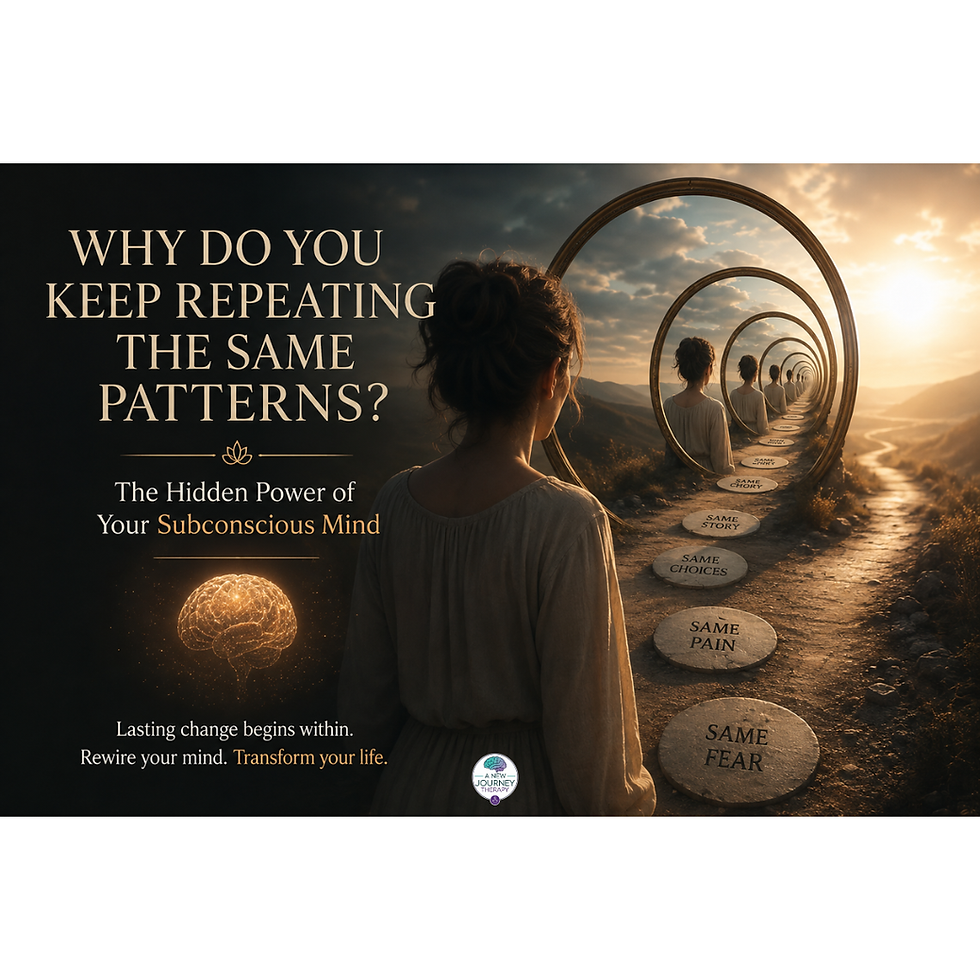
In simple terms, the more often you think a thought or repeat a behavior, the easier it becomes for your brain to repeat it again.
Imagine walking through a forest.
The first time you walk, the path is barely visible.
After walking the same route every day, a clear trail appears.
Your brain works in much the same way.
Repeated experiences become well-worn neurological pathways.
This is incredibly useful when learning to ride a bicycle, drive a car, or play the piano.
But the same mechanism also strengthens emotional patterns.
If your brain has rehearsed worry for years, worrying becomes effortless.
If it has rehearsed self-criticism, self-criticism becomes automatic.
If it has repeatedly associated love with rejection, relationships may unconsciously trigger fear instead of safety.
The good news?
New pathways can also be created.
Childhood: When the Blueprint Is Written
Many of our deepest beliefs develop during childhood.
This isn't because childhood determines our future forever.
It's because the young brain is especially receptive to learning.
During the early years of life, children spend much of their time in slower brainwave states, particularly theta waves, which are associated with imagination, learning, and heightened suggestibility.
In this state, children absorb information from the world around them almost like little sponges.
They don't question everything they hear.
Instead, they make meaning from their experiences.
A child who receives encouragement may develop the belief:
"I can do difficult things."
Another child who experiences frequent criticism may conclude:
"I'm never good enough."
Neither belief is an objective fact.
Both are interpretations created by a developing mind trying to understand its world.
These interpretations often become subconscious programs that continue influencing adult life.
Your Brain Prefers Familiarity Over Happiness
One of the most surprising discoveries for many people is this:
Your brain's primary goal isn't happiness.
Its primary goal is SURVIVAL.
From an evolutionary perspective, familiarity often meant safety.
If a particular response helped you survive emotionally or physically in the past, your brain is likely to repeat it.
Even if that response no longer serves you.
Perhaps withdrawing from conflict protected you as a child.
Today, that same strategy might prevent honest communication in your relationships.
Perhaps constantly pleasing others earned love or approval.
Today, it leaves you exhausted and disconnected from your own needs.
Your subconscious isn't trying to sabotage you.
It's trying to protect you using outdated information.
That realization alone often replaces self-blame with self-understanding.
Emotions Are Powerful Teachers
Neuroscientist Dr. Joseph LeDoux, whose research transformed our understanding of emotional learning, demonstrated that emotionally significant experiences are processed differently from ordinary memories.
When an event carries strong emotion, fear, shame, rejection, excitement, love—the brain remembers it more vividly.
This makes perfect sense.
Your brain wants to remember experiences that might help you survive in the future.
The challenge is that the subconscious doesn't always distinguish between past danger and present reality.
A painful experience decades ago may still trigger the same emotional response today, even when the circumstances have completely changed.
This is why someone may intellectually know they are safe while still feeling anxious.
The conscious mind understands.
The subconscious mind is still responding to an old emotional memory.
The Body Remembers
Another fascinating contributor to our understanding of emotions was neuroscientist Dr. Candace Pert.
Her work explored how emotions influence the body through neuropeptides—chemical messengers that allow the brain and body to communicate continuously.
Her research helped strengthen the idea that our emotional experiences are not confined to the brain alone.
Our thoughts influence our physiology.
Our emotions influence our nervous system.
Our bodies respond to what our minds repeatedly experience.
This helps explain why chronic stress, persistent anxiety, or long-term emotional patterns often affect physical wellbeing as well.
Likewise, creating feelings of safety, confidence, and calm can positively influence the body.
As I witnessed throughout my nursing career, the connection between mind and body is profound. While not every illness originates in emotional experiences, our mental and emotional state can significantly influence how we cope, heal, and experience life.
Why Awareness Alone Isn't Always Enough
Many people have already read countless self-help books.
They understand their patterns intellectually.
They know where they came from.
Yet they still find themselves repeating them.
Why?
Because understanding something consciously doesn't automatically update the subconscious program.
Think of it like reading the instruction manual for swimming.
You may understand every movement perfectly.
But until you actually get into the water, your body hasn't learned the experience.
Real transformation involves more than information.
It involves new emotional learning.
This is why simply telling yourself,
"I'm confident."
or
"I'm worthy."
often doesn't feel believable if your subconscious still carries decades of evidence suggesting otherwise.
The subconscious changes most effectively through emotionally meaningful experiences that allow it to reinterpret old beliefs and adopt new ones.
Rewiring the Brain Through New Experiences
Psychiatrist Dr. Norman Doidge, author of The Brain That Changes Itself, brought widespread attention to the remarkable capacity of the brain to reorganize itself.
His work demonstrates that people can create new neural pathways throughout life through repeated practice, focused attention, and meaningful experiences.
Each time you interrupt an old pattern and reinforce a healthier one, you strengthen new neural connections.
At first, the new pathway feels unfamiliar.
Eventually, it becomes the easier route.
Just like creating a new trail through a forest.
This is why lasting transformation isn't about erasing the past.
It's about creating something stronger than the old pattern.
Why Working With the Subconscious Makes Sense
If patterns originate from subconscious beliefs, doesn't it make sense to work where those beliefs were created?
Rather than spending years battling symptoms, imagine gently exploring the root of the pattern.
Understanding how it began.
Recognizing why it once served you.
Updating the meaning your subconscious attached to those experiences.
Then reinforcing new beliefs that support the life you want to create today.
This is the principle behind Rapid Transformational Therapy (RTT).
Rather than focusing solely on behaviour, RTT helps uncover the subconscious beliefs driving that behaviour.
Once those beliefs are understood and transformed, change often feels more natural because it begins at the source.
You Are Not Your Past
Perhaps the most important message neuroscience offers is this:
Your brain is adaptable.
Your beliefs are learned.
Your patterns are learned.
And what has been learned can be changed.
The experiences that shaped you do not have to define the rest of your life.
You can honour your past without remaining trapped by it.
You can appreciate how your subconscious protected you while giving it permission to create new responses that better serve the person you are today.
Change doesn't happen because you become someone else.
It happens because you reconnect with who you were before fear, doubt, rejection, or limiting beliefs convinced you otherwise.
And when the subconscious begins to align with your conscious goals, transformation becomes not only possible but sustainable.


Comments