
From Understanding the Past to Changing the Pattern


Why Subconscious Work Matters
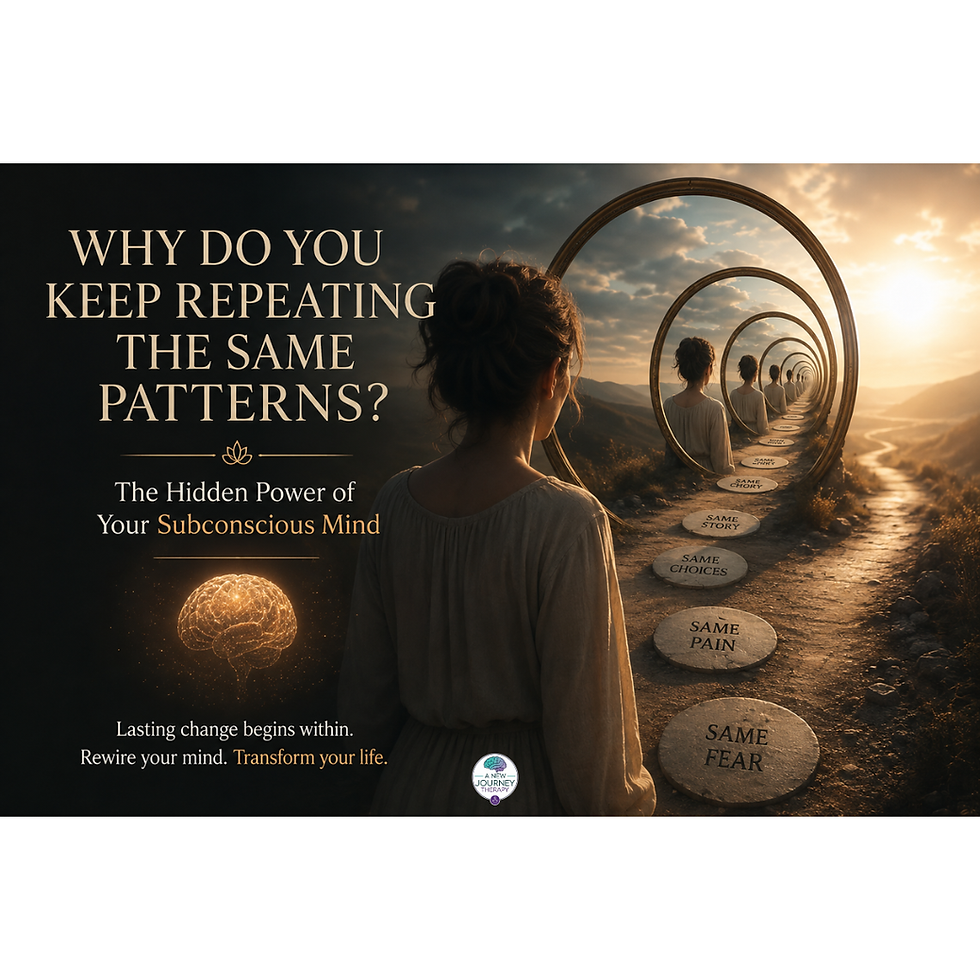
Have you ever said:
"I know exactly why I do this... but I still can't seem to stop."
Maybe you understand why you people-please.
You recognize where your fear of rejection began.
You know why you struggle to set boundaries.
You understand why you become anxious when someone pulls away.
You may even know exactly which childhood experiences contributed to those patterns.
And yet...
The reaction still happens.
This can be incredibly frustrating.
But there is an important reason for it:
Understanding a pattern consciously and changing an automatic emotional response are not always the same thing.
Awareness is powerful.
It opens the door.
But sometimes we need to go deeper—to the beliefs, associations and learned responses operating automatically beneath our conscious awareness.
This is where working with the subconscious mind can become valuable.
When the Conscious Mind Says One Thing and Something Inside Says Another
Imagine consciously knowing:
"I am good enough."
You've read the books.
You've repeated the affirmations.
You've worked on yourself.
You have accomplishments that clearly demonstrate your ability.
Yet you're offered an incredible opportunity and immediately think:
"What if they discover I'm not as capable as they think?"
Your conscious mind says:
"I can do this."
Something deeper says:
"It's safer not to try."
Or perhaps you consciously know you deserve a healthy relationship.
But you repeatedly find yourself attracted to people who are emotionally unavailable.
You tell yourself:
"This time will be different."
And six months later, you're experiencing a familiar emotional pattern.
Why?
Because human behaviour isn't driven exclusively by conscious reasoning.
A great deal of everyday behaviour becomes automatic through learning and repetition.
And what is repeated becomes familiar.
The Subconscious Learns Through Experience
Think about learning to drive.
In the beginning, everything requires conscious attention.
Mirrors.
Brakes.
Signals.
Speed.
Other cars.
Road signs.
Your hands and feet seem to be doing twenty things at once.
Eventually, much of driving becomes automatic.
You no longer consciously think through every movement.
Your brain has learned the pattern.
Emotional responses can also become automatic.
If speaking up repeatedly resulted in criticism, staying quiet may have become your automatic response.
If keeping everyone happy reduced conflict, people-pleasing may have become automatic.
If achievement brought praise and attention, perfectionism may have become associated with worth.
The original circumstances may be long gone.
The learned response can remain.
This is why I often encourage people to stop asking:
"What's wrong with me?"
and begin asking:
"What did my mind learn?"
That question creates an entirely different relationship with the pattern.
The Pattern Once Had a Purpose
One of the most important things we can understand about old behaviours is that many of them once made sense.
The behaviour we dislike today may have been an intelligent adaptation at another point in our lives.
The child who became invisible may have learned that staying quiet prevented conflict.
The child who became perfect may have discovered that achievement brought approval.
The child who took care of everyone else may have learned that being needed created connection.
The child who stopped trusting may have been protecting themselves from disappointment.
Instead of fighting the pattern, we can become curious about it.
What was this trying to do for me?
Sometimes that question reveals something profound.
The subconscious wasn't trying to sabotage you.
It was using an old strategy to protect you.
The strategy simply belongs to another chapter of your life.
Understanding the Root Changes the Conversation
This is why identifying the root of a pattern can be so valuable.
Not because we need to return endlessly to childhood.
And certainly not because we need to find someone to blame.
We return to understand:
What happened?
What did I feel?
What meaning did I give the experience?
What did I come to believe about myself?
Imagine discovering that your difficulty setting boundaries is connected to an early belief:
"If I disappoint people, they won't love me."
Suddenly, the adult behaviour makes more sense.
Now you can examine that belief through adult eyes.
Is love really dependent on saying yes?
Does another person's disappointment mean you're unsafe?
Does having boundaries make you unlovable?
The adult you are today has knowledge, perspective and choices the child didn't have.
And that creates an opportunity to reframe the meaning of the original experience.
Discover. Reframe. Embody.
I think of this transformation in three stages:
Discover
First, we identify the belief underneath the pattern.
Instead of focusing exclusively on:
"How do I stop doing this?"
we explore:
"Why does some part of me believe I need to do this?"
That takes us beneath the behaviour and toward its emotional root.
Reframe
Once we understand where the belief came from, we can examine it from our present-day perspective.
The child may have concluded:
"I'm not important."
The adult can now recognize:
"My parent's absence reflected what was happening in their life. It wasn't a measure of my worth."
The experience hasn't changed.
The meaning has.
And sometimes changing the meaning changes our entire relationship with the memory.
Embody
Understanding something once isn't the end of transformation.
The new belief needs to become familiar.
It needs to be reinforced through thoughts, emotional experiences, choices and behaviours that support it.
Instead of simply saying:
"I am worthy,"
you begin behaving like someone who believes they are worthy.
You establish the boundary.
You express the opinion.
You accept the opportunity.
You choose the healthier relationship.
You allow yourself to be visible.
You create new evidence.
And gradually, the new response becomes increasingly natural.
What Neuroscience Tells Us About Change
There is an encouraging scientific principle behind this process:
the brain remains capable of change.
This capacity is known as neuroplasticity.
Neuroscientist Dr. Michael Merzenich is among the researchers whose work helped establish that the brain can reorganize in response to experience and learning.
Psychiatrist Dr. Norman Doidge later helped introduce the concept of neuroplasticity to a broader public through his writing about the brain's capacity for change.
This doesn't mean we can simply think something once and instantly "rewire" the brain.
Neuroplastic change is more complex than that.
Attention, repetition, learning, behaviour and emotionally meaningful experiences can all contribute to strengthening new patterns.
The principle is profoundly hopeful:
What feels automatic today does not necessarily have to remain automatic forever.
Your brain continues learning.
And you can participate in what you teach it.
Where Hypnosis Fits
Hypnosis is sometimes misunderstood because many people associate it with stage performances.
Clinical hypnosis is very different.
It involves a state of focused attention and increased responsiveness to suggestion while the person remains engaged in the experience.
Research has explored hypnosis for a variety of clinical applications, particularly areas such as pain management and some anxiety-related or procedure-related symptoms.
Researchers including Dr. David Spiegel, Professor of Psychiatry and Behavioural Sciences at Stanford University, have spent decades investigating hypnosis and its effects on attention, perception and brain activity.
For therapeutic work, hypnosis can provide a focused state in which a person can explore associations, memories, beliefs and emotional responses with fewer everyday distractions.
It isn't mind control.
You remain aware.
And you cannot be forced to accept beliefs that fundamentally conflict with your values.
For me, hypnosis is valuable because it creates an opportunity to work not only with what a client consciously knows, but also with the meanings and associations that may be connected to an automatic pattern.
How RTT Approaches the Pattern
Rapid Transformational Therapy (RTT) uses hypnosis together with techniques and concepts influenced by cognitive and behavioural approaches, psychotherapy and NLP.
The purpose isn't simply to tell yourself to stop doing something.
We become curious about why the pattern exists.
We explore experiences and associations connected to it.
We identify the meaning the person has attached to those experiences.
Then we work to reframe outdated beliefs and reinforce perspectives that better support the person's present life.
For example:
Old belief: "If I say no, people will reject me."
New understanding: "I learned to associate approval with safety when I was young."
Reframe: "Healthy relationships can respect my boundaries."
New behaviour:"I can say no while remaining connected, respectful and worthy."
The goal isn't to erase the past.
It is to stop asking the past to make today's decisions.
Subconscious Work and Conscious Action Belong Together
I believe this is one of the most important pieces of transformation.
Subconscious work doesn't replace conscious action.
They support each other.
You can uncover a belief during therapy.
You can reframe its meaning.
You can begin reinforcing a new internal message.
But then life provides the practice.
You set the boundary.
You have the conversation.
You make the different choice.
You respond instead of automatically reacting.
Every new experience becomes evidence:
"I can do this differently."
And that is where change begins moving from something you understand into something you live.
Your Past Is Information, Not an Instruction
Perhaps your childhood taught you to be quiet.
Today, you can develop your voice.
Perhaps it taught you to seek approval.
Today, you can develop self-trust.
Perhaps it taught you that love must be earned.
Today, you can learn what healthy connection feels like.
Perhaps it taught you to expect rejection.
Today, you can create relationships that offer different experiences.
You don't need to hate the old pattern.
You can understand why it existed.
You can even appreciate that at one point it may have protected you.
And then you can tell yourself:
"Thank you for helping me then. I choose something different now."
That is the transition from survival strategy to conscious choice.
Who Do You Choose to Become?
Throughout this three-part series, we've moved through three important stages.
First, understanding.
Our parents were human beings shaped by their own upbringing, circumstances, limitations and experiences. Understanding context doesn't erase harm, but it can help us move beyond a simple story of blame.
Then, empowerment.
As children, we had limited choices. As adults, we have considerably more agency over our relationships, boundaries, beliefs and direction.
And finally: transformation.
Because knowing why you developed a pattern is only the beginning.
Eventually the question becomes:
"What do I want instead?"
You cannot change what happened when you were seven.
But the seven-year-old no longer has to make every decision for the adult you are today.
Your past can be understood.
Your beliefs can be questioned.
Your responses can evolve.
And your future can be created intentionally.
Discover the root. Reframe the meaning. Embody the change.
Your parents may have written some of the first lines of your story.
But the pen is in your hands now.
Ready to Change an Old Pattern?
If you consciously know what you want but find yourself repeatedly returning to the same emotional or behavioural patterns, there may be deeper beliefs worth exploring.
Through Rapid Transformational Therapy, I help clients explore the beliefs and meanings behind those patterns, reframe what no longer serves them, and begin reinforcing a new way of thinking, feeling, and responding.
If you're ready to understand what's beneath the pattern and explore what you want to create instead, I invite you to book a complimentary 30-minute Discovery Call with A New Journey Therapy.
Your past deserves understanding.
Your future deserves your choice.


Comments